Content syndication examples are the specific assets and campaign setups B2B teams push through a third party to reach buyers outside their own audience: a benchmark report sent to named accounts, a webinar registration drive, a buyer's guide behind a form. Each one trades something useful for a contact record. What separates a good example from a weak one is not the asset. It is who received it and what the lead carries back.
Content syndication examples: the short answer
| Asset | Where the buyer is | What the lead tells you | Breaks when |
|---|---|---|---|
| Benchmark or research report | Comparing how peers do it | They care about the topic now | The data is generic or old |
| Buyer's guide or comparison | Choosing between options | They are in an active decision | It reads as a product brochure |
| How-to guide or playbook | Fixing a specific problem | They have the problem | It is too basic for the audience |
| Webinar, live or on demand | Learning, not yet buying | Interest in the topic and speaker | Registrants do not attend |
| Template, checklist, or toolkit | Doing the work this week | They are a practitioner | The reader has no budget |
| Case study | Checking your claims | They are close to a decision | It is pushed too early, to cold accounts |
These are illustrative setups, not client results.
What every working example shares
Three things hold across all six.
- The asset fits the stage. A buyer in the middle of a decision wants a comparison or a benchmark. A buyer at the start wants a definition. Pushing the wrong one pulls the wrong reader.
- The ask fits the asset. A one-page checklist behind a long form loses people. A 30-page report behind a short one attracts anyone.
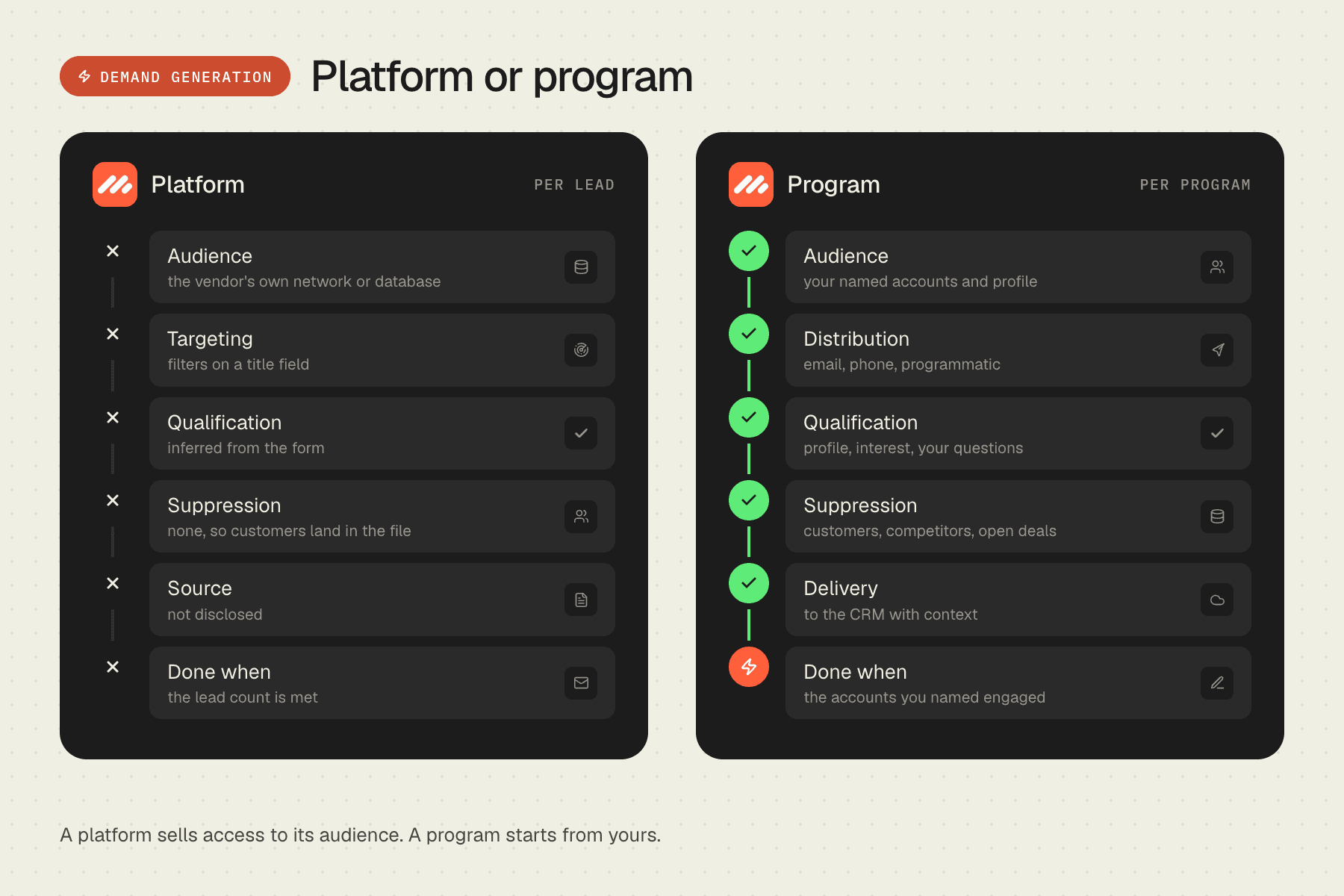
- The audience is named. The example works because it went to accounts and titles written down in advance, not to whoever a vendor's database could match.
Six content syndication examples
1. The benchmark report
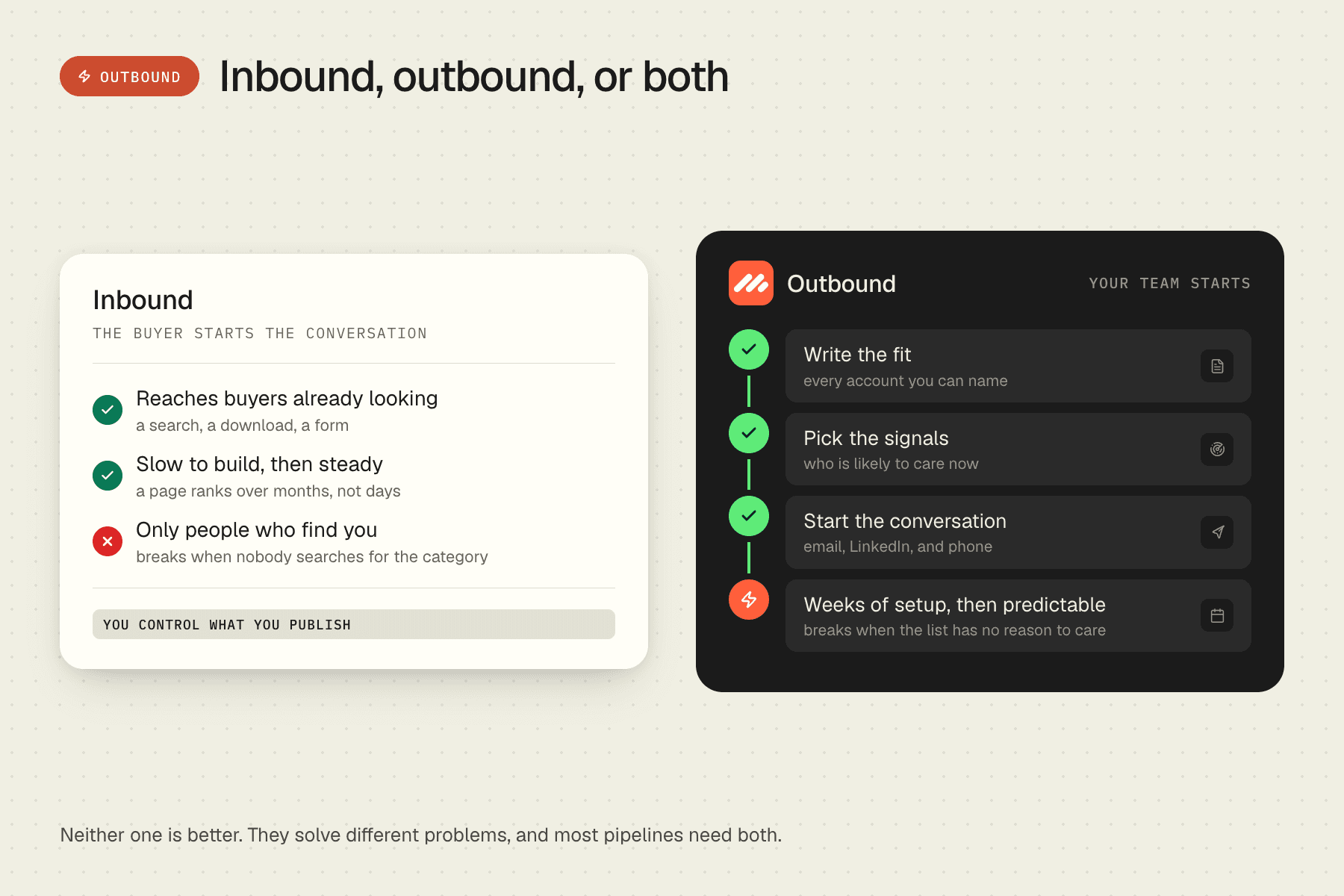
A company that sells RevOps software publishes a report on how mid-market teams run forecasting. It goes to VP and director titles at named accounts by email, a call, and display ads to the same accounts.
The lead tells you the person cares about forecasting enough to read a report on it. Add two questions to the form, such as the current forecasting tool and the team size, and the file arrives with the context sales needs for a first call.
It breaks when the report is thin. A benchmark with no new information is a brochure that has been renamed.
2. The buyer's guide
A vendor in a crowded category publishes a plain guide on how to choose between approaches. It names the criteria, not the vendors. It goes to accounts that fit the profile and are plausibly evaluating.
This one produces the warmest leads, because the reader is already comparing. It also has the smallest audience. Few people are in an active decision at any given moment, so the volume is lower and each lead is worth more.
3. The how-to guide
A services firm writes a step-by-step guide to a task its buyers are stuck on. The reader gets something usable without talking to anyone.
The lead is a practitioner with a live problem. That is a good start for a nurture sequence and a weak start for a same-day sales call. Treat it that way, and the channel looks better than it would if sales rang everyone within the hour.
4. The webinar
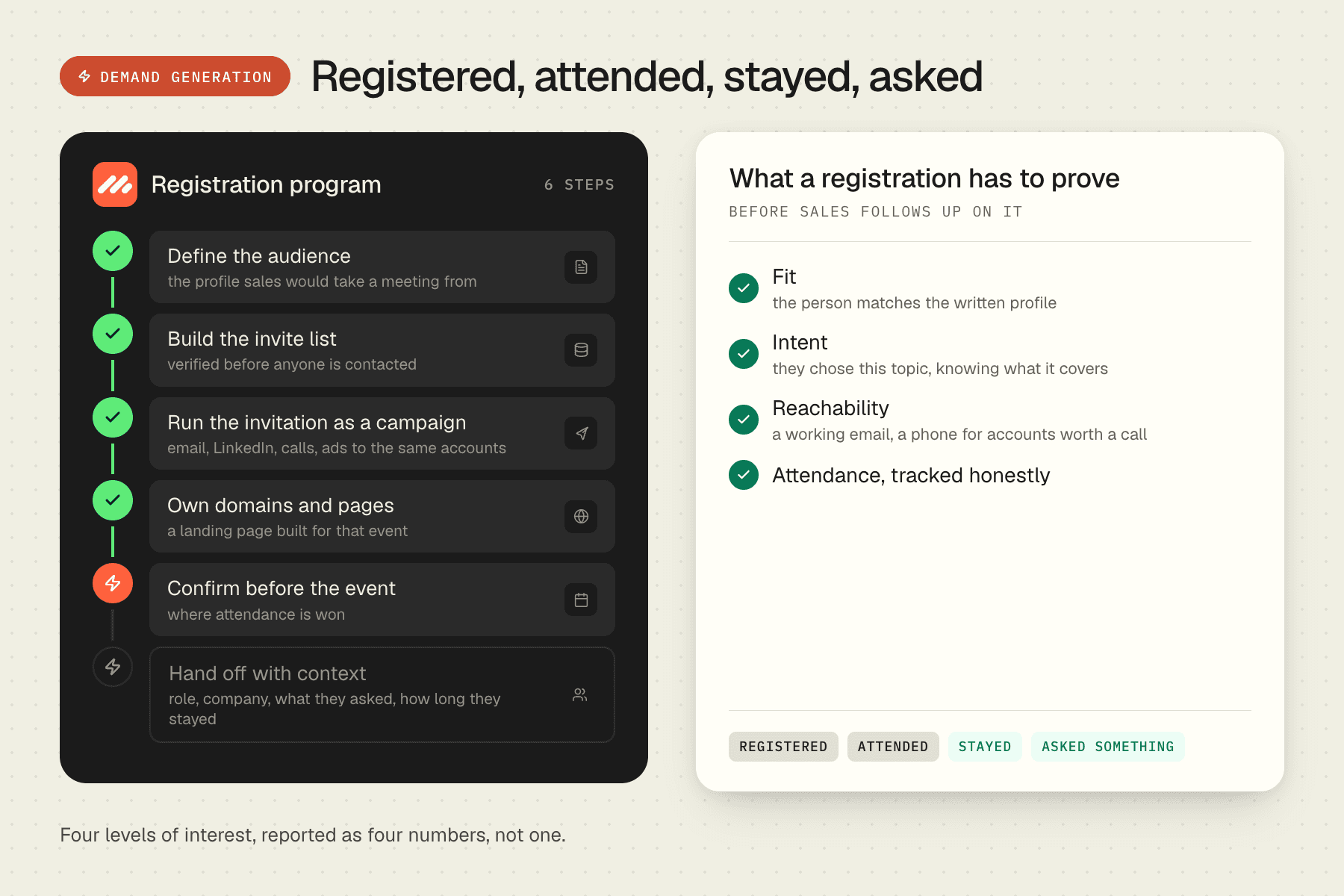
A webinar is syndication with a date attached. Registrants are invited through email and calls, and the attendee list is the product. The full process, including why registration counts mislead, is in event and webinar registration: how the programs actually work.
The useful number is not registrations. It is who showed up and who asked something.
5. The template or toolkit
A spreadsheet, a checklist, or a set of prompts. It is easy to produce and easy to consume. It draws practitioners, not buyers, so it suits teams selling to the person who does the work and weakly suits teams selling to the person who signs.
6. The case study
A case study is the most persuasive asset and the worst cold offer. A stranger will not hand over contact details for a customer story about a company they have never heard of. Use it late: for accounts already engaged, as the next step after an earlier asset.
What to add to the form
The asset gets the lead. The questions make it usable. Match the question to the asset.
| Asset | A question worth adding |
|---|---|
| Benchmark report | What tool do you use for this today? |
| Buyer's guide | Are you evaluating options in the next quarter? |
| How-to guide | What is the biggest obstacle in this task right now? |
| Webinar | What do you want answered in the session? |
| Template or toolkit | Who on your team will use this? |
Keep it to two or three. Each extra field costs completions. The answers must be the respondent's own, not pre-filled by the vendor.
Examples of what not to do
- A generic ebook sent to a whole database. It collects job titles that match and interest that does not.
- A gift card or a prize as the draw. People take the prize and ignore the content.
- Co-registration, where a download is bundled with another form. The person never chose your asset.
- Counting downloads as the result. A download is the mechanism. A qualified lead is the outcome. The MQL, SQL, HQL, and BANT breakdown sets out what each level should prove.
Which example to start with
Start from what sales will do with the lead.
- If sales wants a call this week, run the buyer's guide or the benchmark report, to accounts you have named.
- If sales will nurture first, run the how-to guide or the webinar.
- If you have nothing yet, ask a few customers what they wished they had known before they bought, and write that. The lead magnet brainstorm skill is built for this.
Whichever you pick, run it to a list you wrote. The ABM target account list skill builds one, and the list quality scorecard tells you whether it is any good before anything ships.
Where this fits
Martechs runs content syndication as a program, not a platform. Your asset reaches named accounts by email, phone, and programmatic media, and the responses are qualified before sales steps in. The vendor side of the question is in content syndication platforms vs services. The Content Syndication page explains how the program runs and who it fits.