Outbound lead generation is how a B2B company starts conversations with buyers who have not asked to hear from it. You choose the companies and the people, reach them by email, LinkedIn, and phone, and turn replies into qualified meetings. It works when the targeting is right and the timing is earned. It fails quietly when either one is a guess.
How it differs from inbound
Inbound waits for a buyer to raise a hand: a search, a download, a form. Outbound goes to the buyer first.
That changes what each is good at. Inbound reaches people who are already looking, which is a small slice of any market. Outbound reaches the whole defined market, including buyers who are not looking yet. It suits teams that can name their target accounts, sell a deal large enough to justify the effort, and cannot wait for demand to find them.
Most healthy pipelines run both. This page is about the outbound half.
The work, in the order it runs
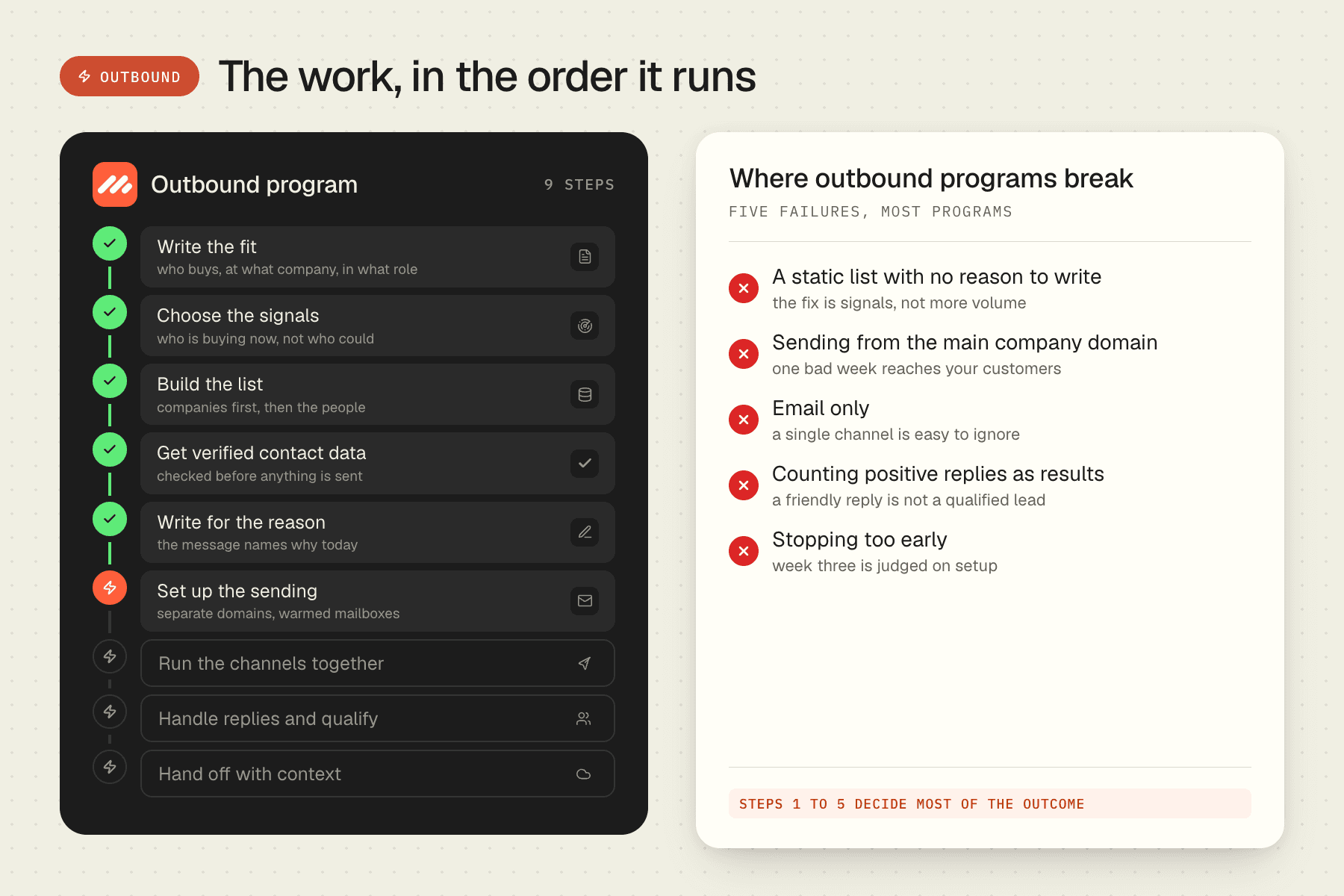
- Write the fit. Who buys, at what kind of company, in what role. Specific enough that two people would build the same list from it.
- Choose the signals. The events that say an account has a reason to care now: funding, hiring in a relevant team, a new leader, a technology added or removed, an expansion. Fit says who could buy. Signals say who is buying now.
- Build the list. Companies first, then the people at them. When databases run thin, public records, filings, registries, and job posts fill the gaps.
- Get verified contact data. A valid email or phone number for each person, checked before anything is sent. A bad list cannot be rescued by good copy.
- Write for the reason. The message names why you are writing today. A line that could be sent to anyone is read by no one.
- Set up the sending. Separate domains that look like yours, mailboxes warmed before use, bounce and spam rates watched daily.
- Run the channels together. Email, LinkedIn, and calls as one sequence, so each touch can refer to the last.
- Handle replies and qualify. Answer objections, follow referrals, and confirm fit, role, and reason before a meeting is booked.
- Hand off with context. The rep sees what was said and why the person took the call.
Steps 1 to 5 decide most of the outcome. Teams that skip to step 7 spend their first month learning that.
What each channel is for
No channel does every job. Using them together is the point.
| Channel | Best at | Weak at |
|---|---|---|
| Reaching many accounts cheaply, with a written record the buyer can forward | Filters, crowded inboxes, and anything sent from a damaged domain | |
| Showing the sender is a real person, and a warm second touch after an email | Volume. Limits are tight and account restrictions are real | |
| Phone | Reaching senior buyers and qualifying in one conversation | Cost per attempt, and it needs trained callers who can run a real conversation |
| Account-based ads | Staying visible to the same accounts between touches | Starting a conversation. Ads build familiarity, not replies |
The ads row is covered on the Programmatic ABM page. The other three are what a Signal-Based Outbound program runs as one campaign.
Where outbound programs break
The same five failures account for most of the programs that do not work.
- A static list with no reason to write. Messages that say nothing get no reply. The fix is signals, not more volume.
- Sending from the main company domain. One bad week of spam complaints reaches the domain customers write to. Use separate sending domains.
- Email only. A single channel is easy to ignore. Replies improve when a call or a LinkedIn touch refers to the email.
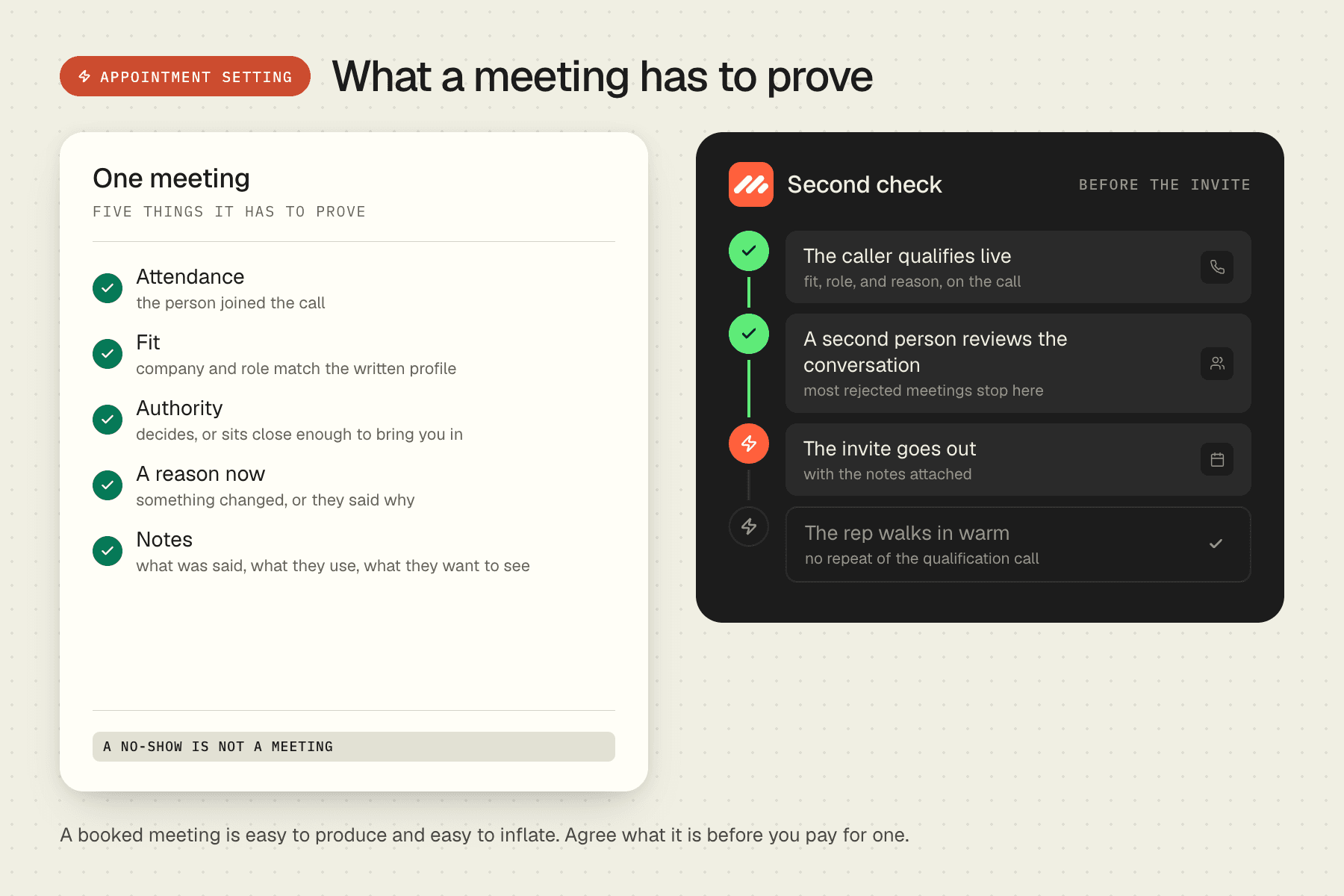
- Counting positive replies as results. A friendly reply is not a qualified lead. Agree what a qualified meeting is before the first send. The MQL, SQL, HQL, and BANT breakdown sets out the levels.
- Stopping too early. The first weeks go to research, list building, and warm-up, with little to show for them. A program judged at week three is judged on setup.
What to measure
Count each stage separately. A single "leads" number hides where the program is leaking.
| Stage | Number to watch | What it tells you |
|---|---|---|
| Delivery | Bounce rate | Whether the list and the domains are healthy |
| Interest | Reply rate, then positive reply rate | Whether the message and the reason land |
| Booking | Meetings booked per positive reply | Whether replies are being worked |
| Attendance | Meetings held | Whether the meeting was real to the buyer |
| Quality | Meetings your sales team accepts | Whether targeting matches the fit you wrote |
| Outcome | Cost per closed deal | The only number that decides if it pays |
Cost per meeting is the number most agencies lead with. It rewards booking over closing. Cost per closed deal, once no-shows and poor-fit meetings are counted, is the one that matters.
Build it or buy it
Running outbound in-house is cheaper only if you already have the parts: someone to write, someone to run the sending, someone to call, and the data tools to feed them. The full comparison, with the costs most teams undercount, is in B2B appointment setting: what an agency does, and how to judge a meeting.
Where this fits
Signal-Based Outbound is our outbound lead generation service. Signals and custom data pick the accounts, email, LinkedIn, and a calling team run as one campaign, and every meeting is qualified live and checked by a second person before it reaches your calendar. Fit criteria and pricing are on the Signal-Based Outbound page. The GTM skills linked below are the workflows behind it, free to read and install.